Arise By Any Other Name
Arise by Any Other Name began with the Tower of Babel and moved outward from it — into twelve stories about the cost of accepting the rules that language imposes, and what becomes possible when those rules break down. The twelve booklets nest together in a screen-printed clamshell box whose assembled spines reconstruct the silhouette of a tower: the structure the stories left behind.
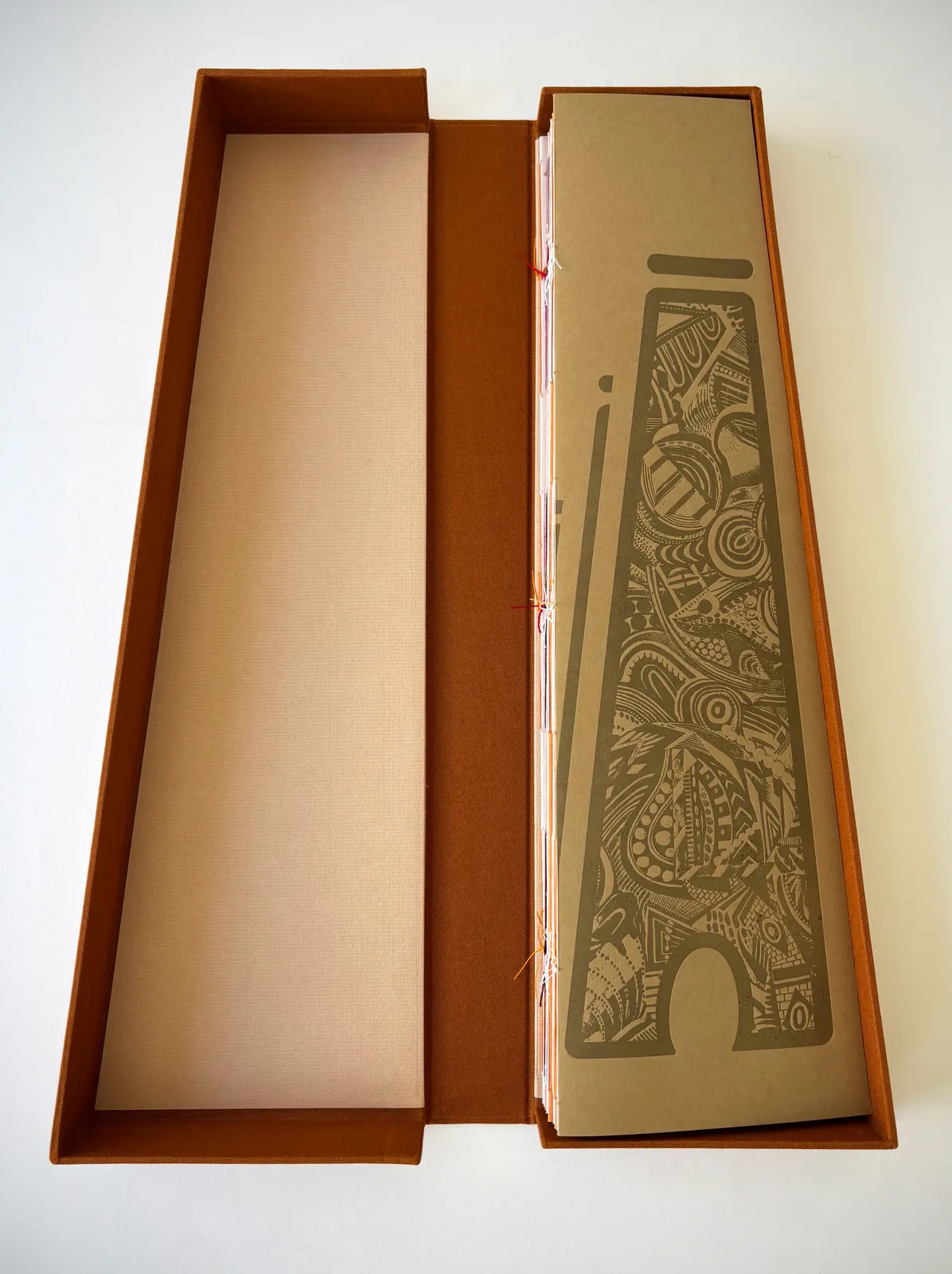
The work was made over several years of weekly meetings between writer/programmer Samuel Mignot, designer/printer Patrick Fenton, and book artist Servane Briand. What made this collaboration unusual (and what shaped the work profoundly) was that it never settled into a division of roles. Every element of every booklet was discussed, questioned, and decided together. We were, in a real sense, learning to translate between three idiolects: Mignot’s literary and scientific intuitions, Fenton’s design and print sensibility, and Briand’s approach as a book artist. The conversation never stopped.
A recurring feature of that conversation was a back and forth journey between analog and digital that none of us could have navigated alone. For the fifth booklet, a story about sleepwalkers converging on a central point, Mignot drew on vector fields as a generative starting place, producing candidate functions that we reviewed together before selecting one, translating it into a visual, deconstructing it for risograph printing, and then deciding that the story itself should move the sleepwalkers’ way: pages 4, 5, and 6 draw the reader toward the center of the booklet, then pages 9, 8, and 7 converge on it from the other direction. The reading order enacts the story’s geometry.
Each booklet is a distinct experience; each has its own constraints, its own surprises, its own outside voices brought in through literary quotes and song lyrics, yet all twelve connect. A shared set of constraints (one letterpress cover, two risograph folios, a riso-printed inner cover, twelve icons linking front to back) held loosely enough to make room for a hallucinogenic molecule, a Khlebnikov word grid, a story printed in reverse, one that reads from bottom to top. There is always another floor.
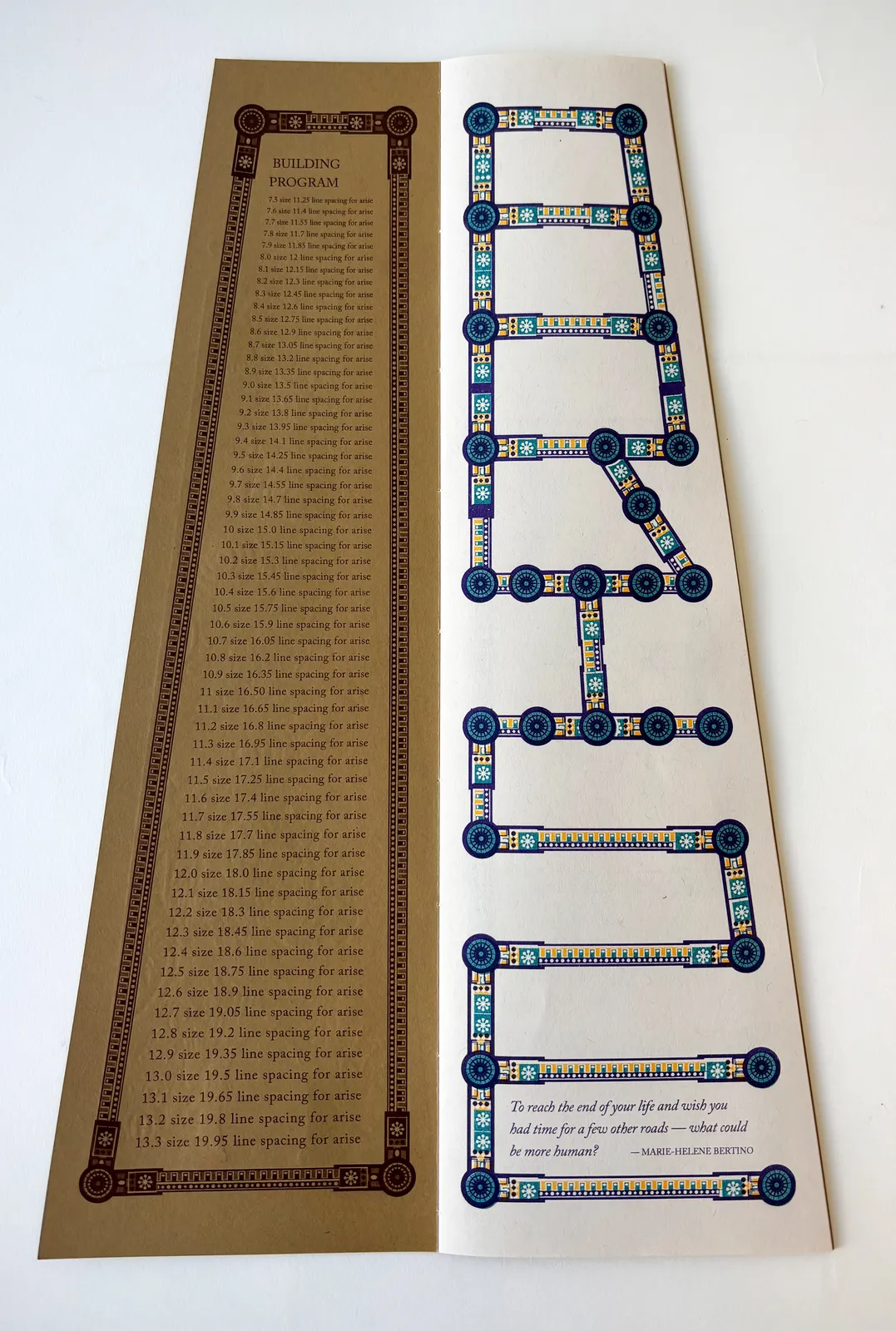
The twelfth booklet opens to the building program: a complete specification, line by line, of the type size and leading used for every story across all twelve booklets (each line increments in size by half a point, set manually throughout). The project was always doing exactly what the Babel stories describe: constructing something out of language, one deliberate line at a time, until it reaches the ceiling.